Buying a Duplex in Wisconsin: How First-Time Homebuyers Can Build Wealth Through House Hacking
EDUCATE 2 OWN | FIRST-TIME HOMEBUYER SERIES
What If Your First Home Could Also Produce Rental Income?
When most people imagine purchasing their first home, they picture a single-family house with a yard, a driveway, and a place to call their own.
But what if your first home could also help you manage your monthly housing expenses?
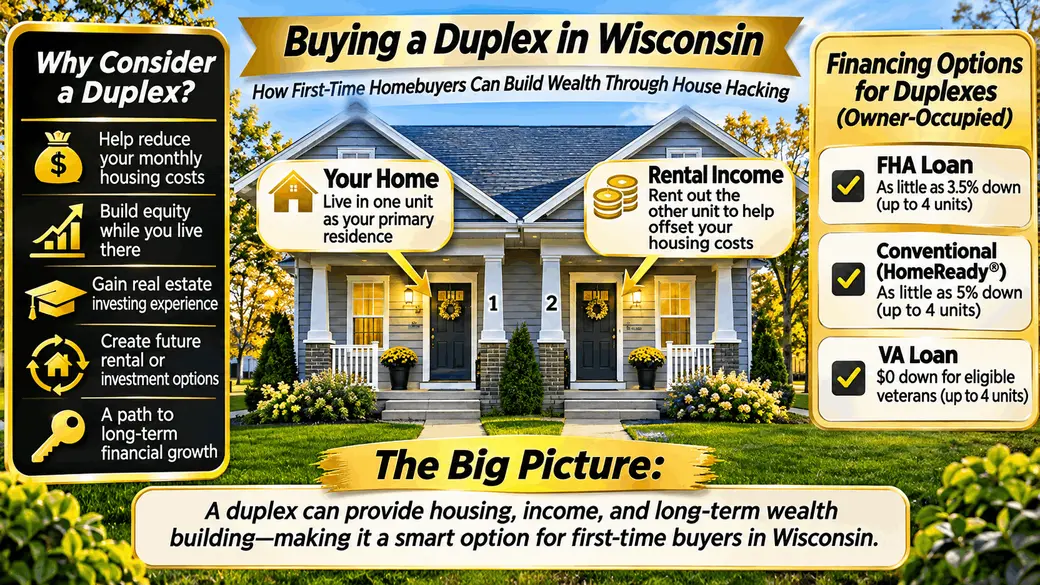
That's one reason some buyers consider purchasing a duplex.
A duplex allows you to own a property containing two residential units. Depending on the property's layout and financing, you may be able to live in one unit while renting out the other.
This strategy is commonly called house hacking.
For some buyers, house hacking can help reduce out-of-pocket housing expenses, build equity, and create opportunities for future real estate investing.
However, rental properties also involve financial risks, maintenance expenses, and legal responsibilities.
Let's explore how buying a duplex in Wisconsin works and whether this approach might fit your homeownership goals.
1. What Is a Duplex?
A duplex is a residential property containing two separate dwelling units.
The units may be arranged:
- One above the other
- Side by side
- In another legally permitted two-unit configuration
Each unit generally has its own living spaces, kitchen, bathroom, and sleeping areas.
Depending on the property, the units may share certain systems or amenities, such as:
- A basement
- A garage
- A yard
- Water service
- Heating equipment
- Other common areas
Before purchasing, verify the property's legally permitted number of units, zoning, occupancy status, and any applicable rental requirements.
Just because a property has two kitchens doesn't automatically mean it's legally recognized as a duplex.
2. What Is House Hacking?
House hacking is a real estate strategy in which someone uses part of their primary residence to generate income or help offset housing expenses.
One common approach involves purchasing a duplex, living in one unit, and renting out the other.
For example:
Example: Owner-Occupied Duplex
Illustrative Monthly Mortgage Payment: $2,100
Includes estimated principal, interest, property taxes, and insurance.
Monthly Rent From Second Unit: $1,200
Difference: $900
Before additional operating expenses, the rental income could offset $1,200 of the $2,100 monthly housing payment.
However, that doesn't mean your actual housing expense will always be $900.
You must also account for repairs, maintenance, vacancies, utilities, potential management expenses, and other property costs.
Rental income is not guaranteed, and expenses can change.
The goal is to understand how rental income could help support your housing budget without depending on unrealistic assumptions.
3. Why Do Some First-Time Buyers Choose Duplexes?
Purchasing a duplex may offer several potential benefits.
Rental Income
The second unit may provide rental income that helps offset certain property expenses.
Building Equity
As you make mortgage payments, part of each payment may reduce your outstanding loan principal.
Over time, this can contribute to equity, although property values can rise or fall.
Learning About Real Estate Investing
Managing a rental unit can help you develop experience with property maintenance, budgeting, tenant relationships, and rental operations.
Potential Long-Term Flexibility
Depending on your financing, financial circumstances, and applicable requirements, you may eventually decide to move into another home and retain the duplex as a rental property.
Multiple Housing Options
Some duplex owners value having separate living spaces within one property.
However, all occupancy and rental arrangements must comply with applicable laws and property restrictions.
Remember: These are potential benefits, not guaranteed financial outcomes.
4. Do You Need 20% Down to Buy a Duplex?
Not necessarily!
Some mortgage programs allow eligible buyers to purchase owner-occupied two-unit properties with significantly less than 20% down.
The key distinction is whether you're purchasing the property as your genuine primary residence or strictly as an investment property.
Owner-occupied mortgage programs generally require you to establish the property as your principal residence and satisfy applicable occupancy requirements.
Financing a property as your primary residence while secretly intending to use it solely as a rental can constitute mortgage fraud.
Always be truthful with your lender about your occupancy intentions.
5. Can You Buy a Duplex With an FHA Loan?
Potentially!
FHA financing allows eligible borrowers to purchase certain owner-occupied properties containing one to four residential units.
For qualified borrowers, the minimum down payment may be as low as 3.5%.
Other FHA requirements apply, including:
- Credit and income qualification
- Mortgage insurance
- Applicable loan limits
- Property eligibility requirements
- Owner-occupancy requirements
- Additional underwriting requirements
For certain three- and four-unit properties, FHA also has a rental-income self-sufficiency requirement.
A duplex isn't automatically subject to that same three- to four-unit test.
However, a lender will still evaluate the property and your ability to qualify for the mortgage.
Example: $240,000 Duplex
Illustrative Purchase Price: $240,000
3.5% Down Payment: $8,400
Remaining Purchase Price Before Financed Fees: $231,600
This example does not include closing costs, mortgage insurance premiums, prepaid expenses, or other required funds.
FHA approval isn't guaranteed simply because you have the minimum down payment.
Ask an FHA-approved lender to review your circumstances and the specific duplex you're considering.
6. Can You Buy a Duplex With a Conventional Loan?
Yes, eligible buyers may finance owner-occupied duplexes using certain conventional mortgage programs.
For example, Fannie Mae's HomeReady program includes eligible two- to four-unit primary residences.
Under applicable automated underwriting guidelines, qualifying borrowers may be eligible for financing with as little as 5% down on certain two- to four-unit properties.
However, not every conventional mortgage product offers the same down payment requirements.
Income limits, credit requirements, mortgage insurance, reserve requirements, and other conditions may apply.
Fannie Mae's HomeReady program also has specific rules concerning the buyer's required contribution from personal funds and the treatment of grants.
Ask a participating lender to explain the program requirements for your circumstances.
Explore Fannie Mae HomeReady →
7. Can Veterans Purchase a Duplex With a VA Loan?
Potentially!
Eligible veterans, service members, and certain surviving spouses may use VA-backed financing to purchase qualifying residential properties containing multiple units.
For a single eligible veteran, VA financing generally permits qualifying residential properties containing up to four units.
Depending on eligibility and financing circumstances, a down payment may not be required.
However, other requirements apply, including:
- VA loan eligibility
- Owner-occupancy requirements
- Lender underwriting
- Property eligibility
- Potential VA funding fees
- Additional requirements when rental income is used to qualify
If you're eligible for VA financing and interested in house hacking, ask a VA-experienced lender to evaluate your options.
Explore VA Home Loan Benefits →
8. Can Rental Income Help You Qualify for the Mortgage?
Possibly!
Some mortgage programs allow lenders to consider qualifying rental income from other units in an owner-occupied property.
However, lenders don't necessarily count every dollar of expected rent.
Depending on the mortgage program, they may evaluate:
- Existing lease agreements
- Appraiser-supported market rents
- Rental income documentation
- Vacancy and expense adjustments
- Your rental property experience
- Other applicable underwriting conditions
For example, Fannie Mae permits eligible rental income from two- to four-unit primary residences when applicable documentation and qualification requirements are satisfied.
The lender determines how much income can be used for mortgage qualification.
Important: The rent you advertise or hope to collect is not automatically the amount the lender can count.
Ask your lender to evaluate the rental-income requirements before making an offer.
9. How Do You Know Whether a Duplex Is a Good Investment?
Before purchasing, evaluate the property as both a home and a potential income-producing asset.
Consider:
- Purchase price
- Estimated monthly mortgage payment
- Property taxes
- Insurance costs
- Current and potential rental income
- Repair and maintenance expenses
- Utility responsibilities
- Vacancy risk
- Property condition
- Long-term financial goals
Don't assume a property is a good investment simply because the rent appears to cover the mortgage.
You should understand the full operating expenses and potential financial risks.
10. Understanding Rental Income vs. Cash Flow
One of the biggest mistakes new investors make is confusing rental income with profit.
Rental income is the money collected from tenants.
Cash flow is the amount remaining after paying applicable property expenses and debt obligations.
Example: Monthly Rental Income
Rent Collected: $1,300
Maintenance Reserve: $130
Vacancy Reserve: $65
Additional Landlord-Paid Expenses: $100
Illustrative Amount Remaining: $1,005
In this example, $1,005 remains available to help cover the property's mortgage and other costs.
This is not a complete cash-flow analysis.
Actual expenses may include additional repairs, utilities, taxes, insurance, capital improvements, management costs, and other obligations.
Major repairs can easily exceed the amount set aside in a single month.
Always build your budget using realistic expenses rather than assuming you'll collect rent without interruptions.
11. What Happens If the Other Unit Is Vacant?
Vacancies are an important risk to consider when purchasing rental property.
If your tenant moves out, stops paying rent, or the unit becomes temporarily uninhabitable, your rental income may decrease or stop.
However, your mortgage payment and other property expenses generally continue.
Before buying a duplex, consider whether you could afford the property without receiving rent for a period of time.
You may also need savings for:
- Advertising the vacant unit
- Cleaning and repairs
- Utility expenses
- Tenant screening
- Unexpected maintenance
- Legal and administrative costs
Before purchasing a duplex, ask yourself: "Could I maintain this property if the rental unit were vacant for three months?" The answer can help you evaluate your financial readiness.
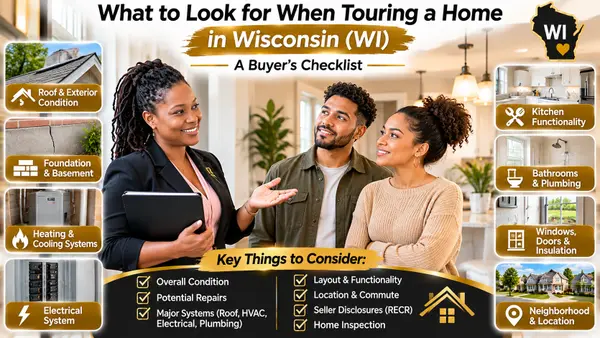
12. What Should You Look for When Touring a Duplex?
Touring a duplex is different from touring a single-family home.
In addition to evaluating the property's overall condition, pay attention to how the two units operate.
Questions Worth Asking
- Are both units legally recognized as residential dwelling units?
- Are the units separately metered for utilities?
- Who pays for water, gas, and electricity?
- Are the heating systems separate?
- How old are the major mechanical systems?
- Are there existing tenants?
- What are the current lease terms?
- Are security deposits being held?
- Are there shared spaces or maintenance responsibilities?
- Are there unresolved property violations?
- What repairs may be needed?
- Are rental licenses or inspections required locally?
In Milwaukee and other Wisconsin communities, older duplexes may have shared utilities, older mechanical systems, or maintenance concerns requiring additional investigation.
Understanding these details before purchasing can help you estimate operating expenses more accurately.
13. What If the Duplex Already Has Tenants?
Purchasing a duplex with an existing tenant can create opportunities and responsibilities.
Depending on the circumstances, you may acquire a property with rental income already in place.
However, you must understand the tenant's existing lease and legal rights.
Before closing, consider requesting and reviewing:
- Existing lease agreements
- Rent amounts and payment history
- Security deposit information
- Utility arrangements
- Known maintenance issues
- Existing notices or disputes
- Other relevant rental records
Existing lease agreements and Wisconsin landlord-tenant law may limit when or how a tenant's occupancy can be changed.
If you intend to occupy a particular unit, confirm that lawful possession of that unit will be available when required by your purchase agreement and mortgage program.
Do not assume purchasing the property automatically gives you the right to require an existing tenant to move out immediately.
14. What Are Your Responsibilities as a Wisconsin Landlord?
When you rent out a unit, you become responsible for complying with applicable landlord-tenant laws and rental property requirements.
Wisconsin landlords have responsibilities involving matters such as:
- Rental agreements
- Required disclosures
- Security deposits
- Property maintenance
- Tenant privacy and entry requirements
- Repairs and habitability
- Proper notices
- Lawful termination procedures
- Fair housing compliance
Security deposits, tenant screening, and other rental practices are regulated.
For example, Wisconsin has rules governing security deposit handling, documentation of preexisting damage, and the timing of deposit returns.
Municipal requirements may add additional obligations.
Before renting out your property, review the current rules that apply to your location.
Wisconsin Landlord-Tenant Guide →
15. Fair Housing Matters
Owning rental property comes with important legal responsibilities.
Federal, Wisconsin, and applicable local fair housing laws prohibit certain discriminatory housing practices.
When advertising and renting your duplex, use consistent and lawful screening criteria.
Avoid making rental decisions based on protected characteristics.
Rules may address discrimination involving race, color, religion, national origin, sex, disability, familial status, and additional characteristics protected by applicable state or local law.
Some owner-occupied properties may qualify for limited exemptions under particular laws, but exemptions differ and should never be assumed.
Consult qualified professionals if you have questions about your obligations.
Responsible real estate investing includes providing fair and lawful housing opportunities.
16. What Insurance Do You Need for a Duplex?
Insurance needs for a duplex can differ from those for a single-family residence.
You'll want to explain to your insurance professional that you intend to occupy one unit and rent out another.
Depending on the property and policy, you may need coverage addressing:
- The building
- Personal property
- Landlord-related liability risks
- Rental income interruption
- Other property-specific exposures
Don't assume an ordinary homeowners insurance policy automatically provides all the protection needed for an income-producing property.
Review the coverage, exclusions, deductibles, and costs before purchasing.
17. Can You Use Down Payment Assistance to Buy a Duplex?
Possibly!
Certain homebuyer assistance programs may allow qualifying owner-occupied two-unit properties.
However, some programs restrict assistance to single-family properties or have additional eligibility requirements.
Wisconsin buyers can explore available options through organizations such as the Wisconsin Housing and Economic Development Authority (WHEDA).
Program eligibility may depend on:
- Property type
- Income
- Credit qualifications
- Occupancy
- Mortgage program
- Purchase price
- Available funding
Confirm that the specific assistance program permits a duplex before relying on those funds.
Explore WHEDA Homebuyer Programs →
18. Could a Duplex Become Your First Investment Property?
For some homeowners, purchasing an owner-occupied duplex can become an introduction to long-term real estate investing.
Consider this hypothetical scenario:
You purchase a duplex and live in one unit while renting the other.
Over time, you make mortgage payments, maintain the property, and develop experience managing a rental.
Several years later, your financial circumstances may allow you to explore purchasing another primary residence.
Depending on financing terms, occupancy requirements, and other obligations, you may decide to retain the duplex as a rental property.
Potential opportunities could include:
- Long-term rental income
- Mortgage principal reduction
- Property appreciation, if market values increase
- Additional investment experience
- Future portfolio expansion
However, real estate values can decline, rents can fluctuate, and maintenance expenses can affect profitability.
Future purchases also require separate financing qualification.
House hacking can be a wealth-building strategy, but it is not a guarantee of wealth.
19. Is Buying a Duplex Right for Everyone?
Not necessarily.
Some buyers prefer the simplicity and privacy of a single-family home.
Others are comfortable taking on the responsibilities of managing a rental property.
Before purchasing a duplex, ask yourself:
- Am I comfortable living near a tenant?
- Can I afford the property without rental income for a period of time?
- Do I have savings for unexpected repairs?
- Am I willing to learn Wisconsin landlord-tenant laws?
- Can I manage tenant communications and maintenance?
- Does the property's layout fit my personal needs?
- Am I prepared for the financial risks of rental ownership?
- Does this strategy align with my long-term goals?
There's nothing wrong with deciding that managing rental property isn't right for you.
The best real estate strategy is one that fits your circumstances and goals.
You don't have to become a real estate investor to build wealth through homeownership. A duplex is one option worth understanding, not a requirement for financial success.
20. Your First Duplex Buying Checklist
Before Shopping
- Review your financial position.
- Explore owner-occupied mortgage options.
- Understand your down payment requirements.
- Ask whether qualifying rental income can be considered.
- Establish a comfortable monthly budget.
When Evaluating Properties
- Confirm legal two-unit status.
- Review current rental information.
- Understand existing tenant rights.
- Evaluate property condition.
- Research rental income and expenses.
- Review utility arrangements.
- Investigate applicable municipal rental requirements.
Before Making an Offer
- Review comparable property sales.
- Understand financing and inspection contingencies.
- Confirm occupancy plans with your lender.
- Evaluate your ability to handle vacancies.
- Consider specialized inspections.
- Review available property and rental records.
Before Becoming a Landlord
- Review Wisconsin landlord-tenant law.
- Understand fair housing requirements.
- Confirm appropriate insurance coverage.
- Prepare lawful lease and screening procedures.
- Establish a maintenance budget.
- Create a plan for vacancies and unexpected repairs.
Frequently Asked Questions
Can I buy a duplex as my first home in Wisconsin?
Yes. Eligible first-time buyers may purchase duplexes using qualifying mortgage programs.
Do I need 20% down to buy a duplex?
Not necessarily. Certain owner-occupied mortgage programs allow qualified borrowers to purchase duplexes with less than 20% down.
Can I buy a duplex with an FHA loan?
Potentially. FHA financing permits eligible owner-occupied properties containing up to four residential units, subject to applicable requirements.
Can I use rental income to qualify for a duplex?
Possibly. Some mortgage programs permit qualifying rental income from additional units. The lender determines the amount that may be counted.
Can I live in one unit and rent out the other?
Yes, when the property, financing, and rental arrangements satisfy applicable legal and contractual requirements.
Can I buy a duplex with a VA loan?
Potentially. Eligible borrowers may use VA-backed financing for qualifying multi-unit residential properties, subject to program requirements.
Do I have to become a landlord immediately?
Not necessarily. However, your occupancy plans, existing tenants, financing requirements, and property expenses must be considered carefully.
What if my tenant stops paying rent?
You remain responsible for your mortgage and property expenses. Any collection, notice, or eviction procedures must comply with applicable law.
Can I eventually rent out both units?
Possibly. You must first satisfy your mortgage's occupancy requirements and other applicable restrictions. Future rental arrangements must also comply with applicable laws.
Is a duplex always a better investment than a single-family home?
No. The answer depends on the property's price, condition, financing, rental income, expenses, risks, and your personal goals.
Continue Your Homebuying Education
Buying a duplex can be an exciting way to begin exploring real estate investing! Before taking the next step, learn about owner-occupied mortgage options, evaluate your financial readiness, and understand the upfront costs of purchasing a property.
Your First Home Could Be the Beginning of Something Bigger
Homeownership can create opportunities beyond simply having a place to live.
For some buyers, purchasing a duplex provides a chance to explore rental income, learn about real estate investing, and work toward long-term financial goals.
I'm Stephanie Stuart, REALTOR® with Epique Realty and founder of Educate 2 Own.
I help Wisconsin buyers and investors understand their options, evaluate properties, and make informed real estate decisions.
Whether you're exploring your first duplex, considering house hacking, or simply learning about the possibilities, I'm here to help you understand the process.
Let's explore whether an owner-occupied investment property aligns with your goals.
Educate. Empower. Own. Thrive!
This article is provided for general educational purposes and does not constitute mortgage, legal, financial, tax, or investment advice. Financing requirements, rental income eligibility, occupancy rules, landlord obligations, property expenses, and market conditions vary. Rental income and investment returns are not guaranteed. Consult qualified Wisconsin real estate, lending, legal, insurance, and tax professionals regarding your circumstances.
Stephanie Stuart, REALTOR® | Brokered by Epique Realty
Recent Posts